Read the Section Called "Why Do We Study the Sun?" How Does the Sun Help to Protect Life on Earth?
World's lord's day: Facts well-nigh the dominicus's age, size and history
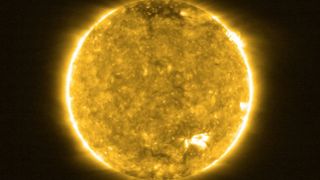
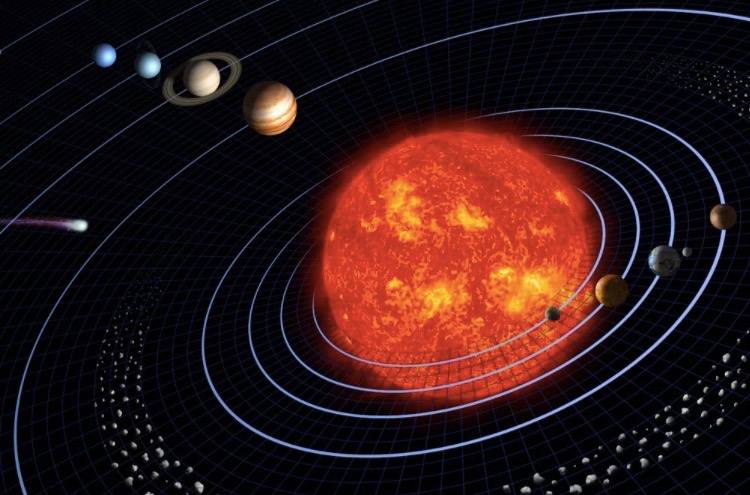
The lord's day lies at the eye of the solar organisation, where information technology is by far the largest object. It holds 99.eight% of the solar system'due south mass and is roughly 109 times the diameter of the Globe — well-nigh one million Earths could fit inside the sun.
The surface of the sun is almost 10,000 degrees Fahrenheit (5,500 degrees Celsius) hot, while temperatures in the core reach more 27 million F (fifteen 1000000 C), driven by nuclear reactions. One would need to explode 100 billion tons of dynamite every second to friction match the energy produced by the lord's day, according to NASA.
The sun is ane of more than than 100 billion stars in the Milky Style. It orbits some 25,000 lite-years from the galactic cadre, completing a revolution once every 250 million years or so. The dominicus is relatively young, function of a generation of stars known every bit Population I, which are relatively rich in elements heavier than helium. An older generation of stars is called Population 2, and an earlier generation of Population Iii may take existed, although no members of this generation are known withal.
Related: How hot is the sunday?
How the lord's day formed
The sun was built-in near 4.half dozen billion years ago. Many scientists think the sun and the rest of the solar system formed from a giant, rotating deject of gas and dust known as the solar nebula. As the nebula complanate because of its gravity, information technology spun faster and flattened into a disk. Virtually of the cloth was pulled toward the eye to class the sun.
Related: How was the sun formed?
The sun has plenty nuclear fuel to stay much as it is at present for another five billion years. Afterwards that, it will swell to go a scarlet behemothic. Eventually, it volition shed its outer layers, and the remaining core will collapse to get a white dwarf. Slowly, the white dwarf will fade, and will enter its final phase as a dim, cool theoretical object sometimes known every bit a blackness dwarf.
Related: When volition the lord's day die?
Internal structure and atmosphere of the sunday
The sun and the atmosphere of the dominicus are divided into several zones and layers. The solar interior, from the inside out, is made up of the core, radiative zone and the convective zone. The solar atmosphere in a higher place that consists of the photosphere, chromosphere, a transition region and the corona. Beyond that is the solar wind, an outflow of gas from the corona.
The core extends from the sun's centre to about a quarter of the fashion to its surface. Although it just makes upward roughly ii% of the sun'south volume, it is almost 15 times the density of lead and holds nearly one-half of the sun's mass. Adjacent is the radiative zone, which extends from the core to seventy% of the way to the sunday's surface, making upwards 32 % of the lord's day's volume and 48% of its mass. Low-cal from the core gets scattered in this zone, so that a single photon often may accept a 1000000 years to laissez passer through.
The convection zone reaches upwardly to the sunday's surface, and makes up 66% of the sun'south volume just only a little more than than 2% of its mass. Roiling "convection cells" of gas dominate this zone. Two master kinds of solar convection cells exist — granulation cells about 600 miles (i,000 kilometers) wide and supergranulation cells about xx,000 miles (30,000 km) in diameter.
The photosphere is the lowest layer of the dominicus's atmosphere, and emits the light we see. It is near 300 miles (500 km) thick, although most of the light comes from its lowest 3rd. Temperatures in the photosphere range from 11,000 F (6,125 C) at the bottom to vii,460 F (4,125 C) at the top. Side by side up is the chromosphere, which is hotter, upwards to 35,500 F (19,725 C), and is apparently made upwards entirely of spiky structures known as spicules typically some 600 miles (1,000 km) beyond and upwardly to 6,000 miles (10,000 km) loftier.
Afterwards that is the transition region a few hundred to a few thousand miles thick, which is heated past the corona above it and sheds most of its light every bit ultraviolet rays. At the top is the super-hot corona, which is made of structures such equally loops and streams of ionized gas. The corona by and large ranges from 900,000 F (500,000 C) to ten.8 1000000 F (6 1000000 C) and tin can even reach tens of millions of degrees when a solar flare occurs. Thing from the corona is blown off as the solar air current.
Related: Space weather: Sunspots, solar flares & coronal mass ejections
The sun's magnetic field
The sun's magnetic field is typically only about twice as potent every bit Earth's magnetic field. Nonetheless, information technology becomes highly concentrated in minor areas, reaching up to 3,000 times stronger than usual. These kinks and twists in the magnetic field develop considering the sunday spins more rapidly at the equator than at higher latitudes and because the inner parts of the dominicus rotate more quickly than the surface.
Related: Huge magnetic 'ropes' drive powerful sun explosions
These distortions create features ranging from sunspots to spectacular eruptions known as flares and coronal mass ejections. Flares are the most violent eruptions in the solar system, while coronal mass ejections are less violent simply involve boggling amounts of matter — a single ejection can spout roughly 20 billion tons (18 billion metric tons) of matter into infinite.
Chemical composition of the sun
Just like near other stars, the sun is made up mostly of hydrogen, followed by helium. Nearly all the remaining thing consists of seven other elements — oxygen, carbon, neon, nitrogen, magnesium, iron and silicon. For every one million atoms of hydrogen in the sun, there are 98,000 of helium, 850 of oxygen, 360 of carbon, 120 of neon, 110 of nitrogen, twoscore of magnesium, 35 of atomic number 26 and 35 of silicon. Yet, hydrogen is the lightest of all elements, and so it only accounts for roughly 72% of the sun'south mass, while helium makes up near 26%.
Related: What is the dominicus made of?

Sunspots and solar cycles
Sunspots are relatively cool, dark features on the sun's surface that are ofttimes roughly round. They emerge where dumbo bundles of magnetic field lines from the sun's interior interruption through the surface.
The number of sunspots varies as solar magnetic activity does — the alter in this number, from a minimum of none to a maximum of roughly 250 sunspots or clusters of sunspots and then back to a minimum, is known as the solar cycle, and averages about 11 years long. At the end of a bicycle, the magnetic field rapidly reverses its polarity.
Related: Largest sunspot in 24 years wows scientists, just too mystifies
History of observing the sun
Ancient cultures often modified natural rock formations or congenital rock monuments to mark the motions of the lord's day and moon, charting the seasons, creating calendars and monitoring eclipses. Many believed the dominicus revolved around the World, with the ancient Greek scholar Ptolemy formalizing this "geocentric" model in 150 B.C. Then, in 1543, Nicolaus Copernicus described a heliocentric (lord's day-centered) model of the solar system, and in 1610, Galileo Galilei'south discovery of Jupiter'south moons confirmed that not all heavenly bodies circled Earth.
To larn more near how the sun and other stars work, after early observations using rockets, scientists began studying the sun from World orbit. NASA launched a series of viii orbiting observatories known equally the Orbiting Solar Observatory between 1962 and 1971. Seven of them were successful, and analyzed the sun at ultraviolet and X-ray wavelengths and photographed the super-hot corona, among other achievements.
In 1990, NASA and the European Infinite Agency launched the Ulysses probe to make the first observations of its polar regions. In 2004, NASA'due south Genesis spacecraft returned samples of the solar current of air to Earth for study. In 2007, NASA's double-spacecraft Solar Terrestrial Relations Observatory (STEREO) mission returned the outset iii-dimensional images of the sun. NASA lost contact with STEREO-B in 2014, which remained out of contact except for a brief catamenia in 2016. STEREO-A remains fully functional.
The Solar and Heliospheric Observatory (SOHO), which terminal year celebrated 25 years in space, has been i of the near important solar missions to date. Designed to study the solar wind, likewise as the lord's day'southward outer layers and interior construction, information technology has imaged the structure of sunspots below the surface, measured the dispatch of the solar wind, discovered coronal waves and solar tornadoes, plant more than than i,000 comets, and revolutionized our ability to forecast space conditions.
The Solar Dynamics Observatory (SDO), launched in 2010, has returned never-before-seen details of material streaming outward and abroad from sunspots, as well equally extreme close-ups of action on the dominicus's surface and the outset high-resolution measurements of solar flares in a broad range of extreme ultraviolet wavelengths.
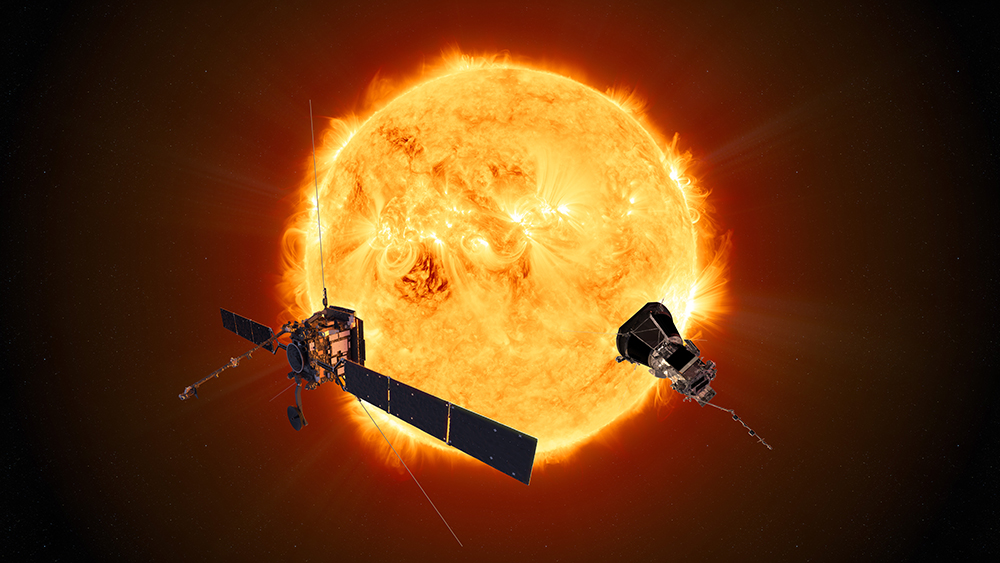
The newest addition to the sun-observing fleet are NASA's Parker Solar Probe, launched in 2018, and ESA/NASA Solar Orbiter, launched in 2020. Both of these spacecraft orbit the sun closer than any spacecraft before, taking complementary measurements of the environment in the vicinity of the star.
During its close passes, the Parker Solar Probe dives into the dominicus's outer temper, the corona, having to withstand temperatures hotter than i million degrees Fahrenheit. At its nearest, the Parker Solar Probe will fly just 4 million miles (6.v meg km) to the sun'southward surface (the altitude between the sun and Earth is 93 meg miles (150 million km)). The measurements it makes are helping scientists learn more well-nigh how free energy flows through the sun, the construction of the solar current of air, and how energetic particles are accelerated and transported.
Related: NASA Parker Solar Probe nails close flyby of sunday as its space weather condition cycle ramps up
While Solar Orbiter doesn't fly every bit close as the Parker Solar Probe, it is equipped with high-tech cameras and telescopes that take images of the sun's surface from the closest distance always. It was not technically possible for the Parker Solar Probe to acquit a camera that would expect straight at the sunday'south surface.
At its closest, Solar Orbiter will pass at about 26 1000000 miles (43 1000000 km) away from the star — about 25% closer than Mercury. During its offset perihelion, the point in its elliptical orbit closest to the sunday, the spacecraft approached the sun to about half the altitude from earth. The images caused during the beginning perihelion, released in June last year, were the closest images of the dominicus ever taken and revealed previously unseen features on the star'due south surface — miniature flares dubbed the campfires.
After Solar Orbiter completes a few close passes, mission controllers will offset elevating its orbit out of the ecliptic airplane in which planets orbit, to enable the spacecraft'due south cameras to accept the kickoff ever close-upwards images of the sun's poles. Mapping the activity in the polar regions will assist scientists better understand the sun'south magnetic field, which drives the 11-year solar cycle.
This article was updated on June 9, 2021 by Infinite.com senior writer Tereza Pultarova.
Join our Infinite Forums to keep talking space on the latest missions, night sky and more than! And if you accept a news tip, correction or comment, let us know at: community@space.com.
Source: https://www.space.com/58-the-sun-formation-facts-and-characteristics.html

Post a Comment for "Read the Section Called "Why Do We Study the Sun?" How Does the Sun Help to Protect Life on Earth?"